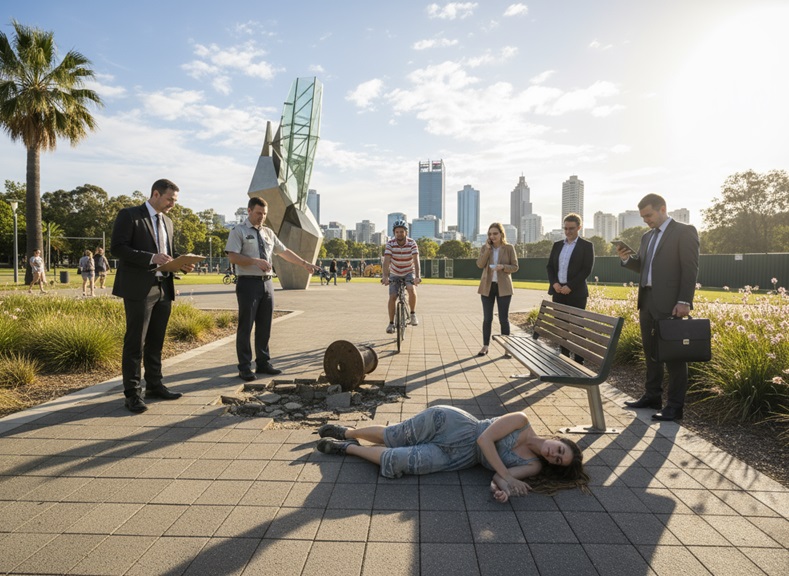
A public liability claim WA arises when someone is injured because another party failed to take reasonable care. Public liability laws exist to protect individuals in everyday settings whether you are shopping in a supermarket, attending a public event, walking through a park, or visiting a business.
Negligence in these situations can have serious consequences. An unmarked wet floor, faulty handrails, or falling debris can all lead to significant injury. When these accidents occur, the injured person may be entitled to compensation.
At Separovic Injury Lawyers, our experienced legal team has successfully represented many clients in negligence public liability WA matters. We understand the impact these injuries have on people’s lives and work tirelessly to achieve the financial security and justice our clients deserve.
What is Public Liability?
Public liability is the legal principle that ensures people, businesses, and organisations take reasonable steps to avoid causing harm to others. It is based on negligence law and applies broadly to public and private spaces.
For example:
- A shopping centre must ensure aisles are free from hazards.
- A local council must maintain public footpaths.
- A property owner must keep their premises safe for lawful visitors.
- An event organiser must ensure adequate crowd control and safety measures.
If these duties are ignored and someone is injured, a public liability claim WA allows the injured party to recover compensation.
The Legal Framework in WA
Public liability in Western Australia is primarily governed by:
- Civil Liability Act 2002 (WA): Establishes the rules for negligence claims, including duty of care, breach, causation, contributory negligence, and damages.
- Limitation Act 2005 (WA): Sets time limits for making claims, generally three years from the date of injury.
- Occupiers’ Liability Law: Imposes duties on property owners and occupiers to maintain safe premises.
These laws ensure that claims are assessed fairly, balancing the rights of injured individuals with the responsibilities of businesses and organisations.
The Three Pillars of a Public Liability Claim
To succeed in a negligence public liability WA claim, three elements must be proven:
Duty of Care
The defendant must owe the claimant a duty of care. This duty arises when it is reasonably foreseeable that one person’s actions (or inactions) could cause harm to another.
Examples in WA include:
- Councils maintaining roads and footpaths.
- Property managers inspecting and repairing defects.
- Dog owners controlling their animals in public spaces.
Key Takeaways:
- Duty of care is a legal obligation to prevent foreseeable harm.
- Businesses, councils, and private individuals may all owe this duty.
Breach of Duty
A breach occurs when the defendant fails to act as a reasonable person or organisation would under the same circumstances.
Examples:
- A supermarket that fails to promptly clean up a spill.
- A café that ignores known water leaks without signage.
- A builder leaving equipment unsecured, causing injury.
This is the core of negligence public liability WA.
Causation
It must be proven that the breach of duty directly caused the injury. This can sometimes be complex, particularly if multiple factors contributed to the harm.
For example:
- A customer slips on a wet supermarket floor (breach) and sustains a broken hip (causation).
- A pedestrian trips on a raised footpath left unrepaired by the council (breach) and suffers ligament damage (causation).
Key Takeaways:
- Breach alone is insufficient.
- The injury must flow directly from the negligent act or omission.
Case Law Examples in WA
Court cases illustrate how public liability claim WA matters are determined.
- Strong v Woolworths Ltd [2012] HCA 5: A customer slipped on a chip in a shopping centre. The High Court found Woolworths liable because reasonable cleaning systems were not in place.
- Woolworths Ltd v Ryder [2005] NSWCA 526: A shopper injured by a spillage successfully claimed damages.
- Australian Safeway Stores Pty Ltd v Zaluzna (1987): Established that occupiers have a duty to take reasonable care to avoid foreseeable risks.
These cases show how courts examine evidence of duty, breach, and causation in negligence public liability WA claims.
Examples of Public Liability Claims
Common examples where claims arise include:
- Slip and fall accidents: Supermarkets, shopping centres, or restaurants failing to address hazards.
- Defective premises: Poorly maintained stairs, broken handrails, or faulty lighting.
- Council negligence: Uneven footpaths, potholes, or unsafe public areas.
- Falling objects: Building sites or commercial premises where debris is not secured.
- Animal attacks: Owners failing to control aggressive dogs.
- Event injuries: Poor crowd control, inadequate barriers, or unsafe equipment.
A tradesman once joked, “It’s not enough to lay the bricks straight it’s about making sure no one trips over them while they set.” That everyday wisdom reflects the heart of public liability: safety is as important as the task itself.
How to Start a Public Liability Claim in WA
If you believe you have a claim, early steps are critical.
- Seek medical treatment – Your health is the priority, and medical records form key evidence.
- Document the incident – Photographs, incident reports, and CCTV footage can be vital.
- Gather witness statements – Independent accounts support your version of events.
- Keep expense records – Medical bills, lost wages, and out-of-pocket costs should be documented.
- Seek legal advice – A public liability lawyer in Perth can assess your eligibility and handle negotiations with insurers.
Time Limits for Making a Claim
Under the Limitation Act 2005 (WA):
- Most claims must commence within three years from the date of injury.
- For children, the limitation period may not start until they turn 18.
- Extensions may apply in limited cases, such as delayed discovery of an injury.
Delaying risks your entitlement. Early legal advice ensures compliance with these strict timeframes.
Compensation Available
A successful public liability claim WA may include compensation for:
- Medical expenses and rehabilitation costs.
- Loss of income (past and future).
- Pain and suffering.
- Loss of enjoyment of life.
- Domestic care and support needs.
The exact amount depends on the severity of the injury, the impact on lifestyle, and the strength of evidence.
Defences to Public Liability Claims
Defendants may argue:
- Contributory negligence – The claimant contributed to the accident (e.g., ignoring warning signs).
- No breach of duty – Reasonable precautions were taken.
- No causation – The injury was unrelated to the alleged negligence.
Even where contributory negligence is found, compensation may still be awarded, but reduced.
Frequently Asked Questions
How much is my claim worth?
Compensation depends on medical evidence, lost income, and personal impact. No two claims are identical.
How long does a claim take?
Some settle within months, while others may take years if liability is disputed.
Do I need to go to court?
Most claims resolve through negotiation with insurers. Court action is generally a last resort.
What if I can’t afford legal fees?
At Separovic Injury Lawyers, we act on a “no win, no fee” basis for many claims.
Key Takeaways
- A public liability claim WA arises when negligence causes injury in a public or private setting.
- Proving duty of care, breach, and causation is essential.
- Legislation sets strict time limits.
- Compensation can cover medical costs, lost income, and quality of life impacts.
- Early legal advice is critical for protecting rights.
Next Steps
If you believe you have a valid claim, professional guidance is essential. At Separovic Injury Lawyers, our team will:
- Assess your eligibility for a claim.
- Explain your rights under WA law.
- Manage negotiations with insurers.
- Represent you in court if required.
By acting promptly, you protect your entitlement to fair compensation. Contact us today for a free, no-obligation consultation.


